Marketing Engineering
Why Joining Your Data Is the Unsung Hero of Performance Marketing
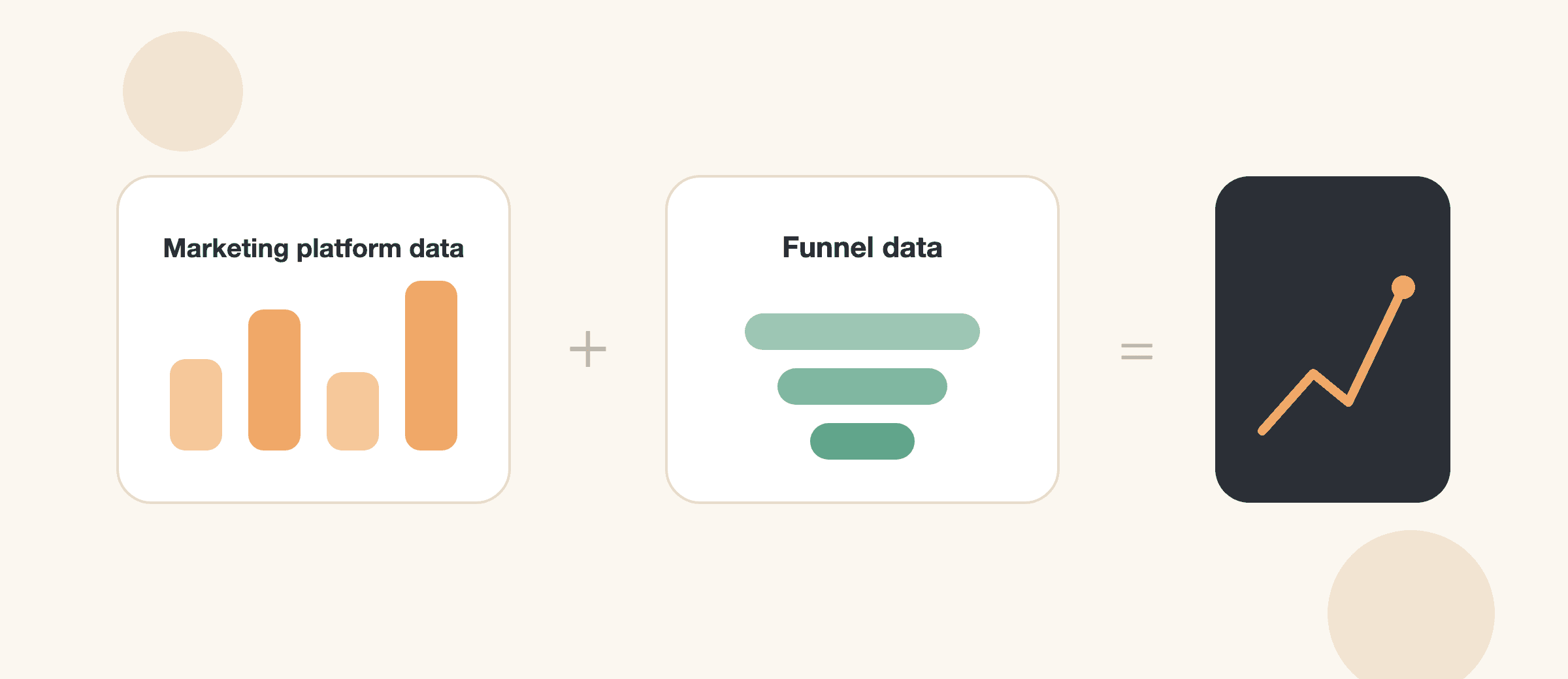
Joining your marketing platform data to your funnel data is the unsung hero of performance marketing. Skip it and you optimize toward the wrong numbers, and neither your team nor your AI agents can see what really drives pipeline.

Scott Kaplan
Posted on Sep 18, 2026
Joining your marketing platform data with your funnel data is the unsung hero of performance marketing. Skip it and you make decisions on the wrong numbers, and nobody on the team, or your AI agents, can see what actually drives pipeline. Whether you're a marketing leader, a practitioner or an agent, this one will find you.
A lot of performance marketers have shiny object syndrome (guilty as charged). Experiments, new channels, new agents. Those things are valuable. But it's like fielding a football team full of quarterbacks and wide receivers while neglecting your offensive line, your defense and your special teams. You'll have flashes of brilliance. You'll score some points. You'll still take the loss.
Joining and aggregating your data is the offensive line. Nobody notices it until it breaks, and worse, nobody names it as the problem. Other initiatives take the blame instead. I've seen it cripple performance marketing teams, and I've seen it elevate them, very consistently. It was true back in the day, it's true today, and it matters even more as we move toward AI-first, agentic go-to-market.
I'll ground this in B2B SaaS demand capture: paid search, shopping and Performance Max on Google and Bing. It's the most illustrative.
What does joining your data actually mean?
It means stitching your buy-side data (the marketing platforms) to your sell-side data (the funnel and revenue in Salesforce, HubSpot or whatever your source of truth is). You don't need to be a data engineer, but you do need a few concepts:
- IDs. Something has to carry from the ad click to the CRM record, and it has to be clean. A Google click ID, a Microsoft click ID or UTMs, for example.
- Group bys and roll-ups. Rolling individual leads up to the same level as your spend, like date and campaign.
- Joins. Lining those roll-ups up against spend so cost and outcomes sit on the same row.
- Cohorted versus non-cohorted. Do you count a conversion on the day it happened, or on the day of the click that drove it? Look at both.
What goes wrong when you don't join your data?
You make bad decisions. The platforms have tons of rich data. But if what you see in the platform doesn't correlate to the business outcomes your stakeholders care about, you're optimizing toward the wrong thing.
Campaign A has a $200 CPA, campaign B has a $1,000 CPA. Easy call: put the money in A. Then you stitch the funnel data to the marketing platform data and campaign A is returning $1 of revenue for every dollar spent while campaign B is returning $3, a 1x ROAS versus 3x. Move the budget to A and pipeline tanks.
You can't hand work off. When you bring in another practitioner, an agency or a vendor, they need the same visibility and transparency you have.
You stay in the weeds. Without a system, the joins happen by hand, in a hacky way, or they don't happen at all. App hopping. Brittle joins. The opportunity cost is huge and it slows you down.
Executives get different narratives. Leadership wants to see ROI metrics and how the data lines up. Without joined data, the story changes depending on which report they're looking at. And there are few things cringier than a leadership meeting where two reports disagree and nobody can say which one is right. That's not on leadership. It's a symptom of data that was never stitched together.
What should performance marketers do about it?
There are two jobs here, and you want them running in tandem.
The first is passing your funnel data back into the native platforms (offline conversions). Both Google and Microsoft let you do it through a native integration with Salesforce or HubSpot, or by uploading outcomes, so the platform optimizes toward qualified pipeline instead of raw form fills. Know that what comes back is self-reported attribution, so it won't tie out perfectly with your source of truth.
The second is your source of truth: the dashboards and joins that tell you what actually happened. That's the one this post is really about. There will usually still be a disconnect between the two, because the BI team reports on channels with its own attribution model. That's unavoidable. Understand it. And this isn't a multi-touch versus last-touch argument. Pick whatever model your company believes. None of them work if the data was never joined in the first place.
This is where the rubber meets the road. Sit down with ops and data engineering and understand what IDs are being passed through, how the data is being grouped, and whether it's cohorted or non-cohorted. Map out and document what you want the joins to look like, from the marketing platforms to the funnel data.
Plenty of tools do this, and with the tools and agents available now you can stay out of the weeds. You still need the fundamentals to QA what comes out the other side. The goal is a systematic, robust setup where everyone can see under the hood.
Why does this matter more with agents?
Joined data now goes beyond dashboards and reporting. Thanks to LLMs and MCP servers, you can build custom tools and truly build your own optimization platform. You can act on your data, not just look at it. But the models need context. They need the right artifacts, and that means joined data.
What about channels without clean attribution?
Measuring demand creation and push channels like display and paid social is hard, full stop. Click-based attribution won't tell a pretty story there.
Joined data frees you up to look at looser correlations, run multi-touch attribution, and see relationships between those efforts and pipeline. Often the join is just on date, lining up activity against pipeline over the same period. It also empowers teams that don't have clean metrics to measure against. Events and email can line up results against a run date or a drop date.
And the big one, AEO (answer engine optimization): more of the buyer journey is going zero click, with people getting answers from LLMs instead of clicking through. Mapping citations, mentions and sentiment to your direct and branded traffic is the same kind of work.
What this means for you
- Leaders: this is the investment that makes every other channel measurable. Make it a priority for your performance marketing team.
- Practitioners: the numbers in your platform are not the numbers your company runs on. Know the gap, and know how it's calculated.
- External agencies and vendors: ask for reports that stitch platform data to the client's funnel. Without them you're optimizing toward whatever the platform rewards, and you'll get judged on pipeline anyway.
- Agents: an agent only knows what you feed it. Give it platform data and it optimizes toward platform metrics. Give it joined data and it can optimize toward pipeline.
Run the creative tests. Launch the agents. You need them. But joining your data together in a systematic way should be one of the first things a performance marketing team does. Back in the day, today, and going forward.