Performance Marketing
Campaign Limited by Budget: 7 Ways to Fix It
If your campaign is limited by budget, it's leaving traffic on the table. Confirm what good looks like, raise the budget about 15% when CPA or ROAS beats goal, fix inefficient spend when it doesn't, then track the change.

Scott Kaplan
Posted on Sep 16, 2026 · Updated Sep 22, 2026
Sometimes you hear a comment that sticks with you and shapes your modus operandi for life. That happened to me back in the day at a Google off-site. A wise Google exec said: "The number one thing I look at when evaluating whether a campaign manager knows what he or she is doing is whether their campaigns are limited by budget."
His point: if your campaign is limited by budget (it's hitting its budget cap and losing impression share to budget), you have two moves:
- Raise budgets steadily if performance is strong, meaning CPA or ROAS is better than goal.
- Reduce inefficient spend, so you get more volume at a lower cost.
The levers for reducing inefficient spend go beyond this article, but the usual suspects include dropping bids, audience adjustments and day parting, plus the less elegant but viable decision to chop budgets.
The intent of this post isn't to get into every optimization lever. It's to point out that if you're looking for a high-impact, low-effort way to improve your SEM campaigns, budget adjustments are the way to go.
Why does a campaign end up limited by budget?
A campaign ends up limited by budget because your spend exceeds your daily budget. This can be a function of overall traffic volume or cost per click. When that happens, the campaign is losing impression share to budget.
How common is lost impression share to budget?
You can expect an account to have at least one campaign with at least 20% lost impression share to budget, in my experience. In Google Ads, you'll find it in the Search lost IS (budget) column.
Is raising the budget always the answer?
No. Let me be clear, this isn't a panacea. When you enter more auctions, quality inevitably erodes.
For nascent campaigns, the ratio of added revenue or conversions to added cost can be 2:1 or higher. For more established campaigns, 1:1, and sometimes worse, can be the outcome.
What should you do when your campaign is limited by budget?
Confirm what good looks like, look across Google and Bing, and analyze by brand and non-brand separately. Then raise budgets in steps, fix inefficient campaigns before cutting them, and track every change.
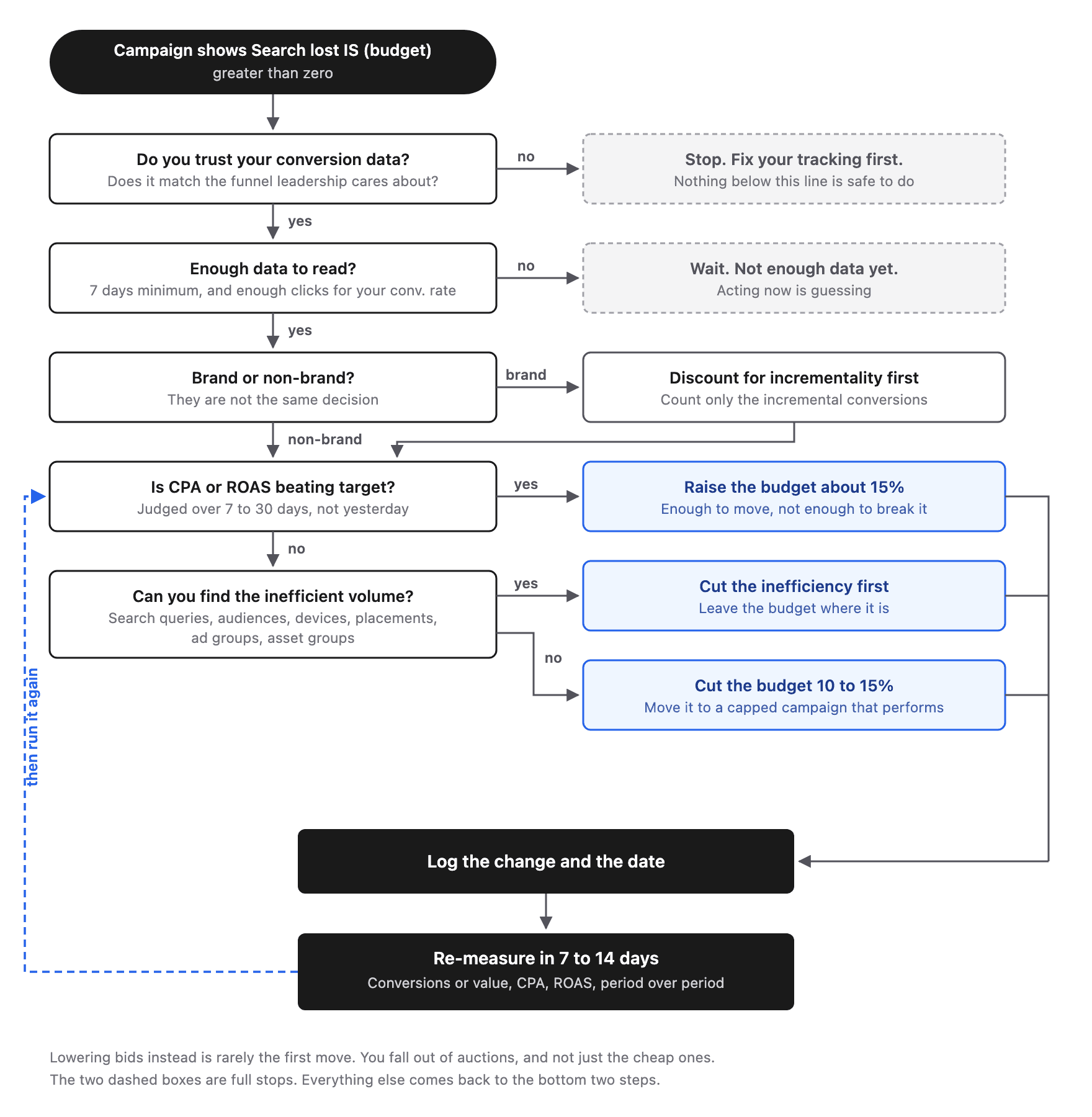
The decision tree, step by step:
- Check your conversion data. If it doesn't match the funnel leadership cares about, fix tracking first.
- Check you have enough data: at least seven days, and enough clicks for your conversion rate. If not, wait.
- Separate brand from non-brand. For brand, count only the incremental conversions, then continue to the next step like any other campaign.
- If CPA or ROAS beats your target over 7 to 30 days, raise the budget about 15%.
- If it doesn't, find the inefficient volume and cut it. If you can't find it, cut the budget 10 to 15% and move it to a capped campaign that performs.
- Log the change and the date, re-measure in 7 to 14 days, then run it again.
Here are the seven moves, in the order I work through them.
| The move | When to use it | What to expect |
|---|---|---|
| 1. Establish what good looks like | Before you touch anything | A CPA or ROAS target you trust |
| 2. Account for Google's smart bidding change | Target CPA or target ROAS campaigns | Performance closer to target, not way past it |
| 3. Look at Google and Bing together | Always | Volume you are ignoring on the smaller engine |
| 4. Separate brand from non-brand | Both are capped | Brand discounted for incrementality first |
| 5. Raise budgets in steps | CPA or ROAS beats goal | More volume, efficiency roughly held |
| 6. Fix inefficiency before you cut | Capped and performance is poor | Same budget, better return |
| 7. Track every change | Every time | A record that tells you whether it worked |
1. Establish what good looks like
Establish what good looks like from a CPA and ROAS perspective. It's easier to work off platform data, so ideally you're mapping your source-of-truth pipeline and revenue data back into the native platforms. Google and Microsoft Advertising both offer offline conversions and native integrations.
If your conversion data in-platform doesn't correlate to the source-of-truth funnel data your leadership team cares about, stop and address that first. I'd advise against gnarly VLOOKUPs, joins, or LLM data mashups.
When you look at performance, use at least a seven-day window to account for day-of-week variation, and up to 30 days.
2. Account for Google's smart bidding change
Starting August 17, Google changed how target-based bidding works for campaigns that are limited by budget (Google Ads Help). It essentially pegs your effective CPA or ROAS to your target CPA or target ROAS if you're using those bid strategies.
Thus, the days of your performance wildly outperforming your targets are going away. So use your discretion when defining what good looks like.
3. Look at Google and Bing in tandem
Stating the obvious, but I've seen many companies sleep on Bing. Yes, it's smaller volume, but volume is volume.
4. Separate brand from non-brand, with an eye toward incrementality
If brand search campaigns are hitting budget caps, know that only a fraction of that is incremental. Assume only 20% of it is, and that's conservative. In one geo holdout test, Polar Analytics found brand search added just 2% to total traffic, while organic traffic dropped 14%.
Assuming non-brand is more incremental, even a higher cost is better. Toward that end, make sure you're making use of negatives in your Search and Performance Max campaigns.
That said, non-branded terms can get pretty loose. The fact that you're capped there isn't automatically an argument to spend more. It depends on whether that non-brand traffic is performing.
5. Raise budgets in steps
If a campaign is performing well, raise the budget incrementally. I'm a fan of 15%. That's typically enough to move the needle without being too aggressive. Then monitor performance, and keep going if you're driving more volume with CPA or ROAS staying within threshold.
6. If performance is inefficient, fix it before you cut
If you're hitting your budget cap and performance is inefficient, do your typical optimization checks: mining asset groups, ad groups, keywords, search queries, audiences and device multipliers. Look for the things that are really driving inefficient performance.
Focus on things with high volume. As a rule of thumb, does it have as many clicks as you need to get meaningful conversion data? If your conversion rate is 1%, make sure you have at least 100 clicks.
We don't typically have unlimited budgets, so at times it's a rob-Peter-to-pay-Paul situation. You can always bring a budget down by 10 or 15%.
Certainly when you're hitting your budget cap, there's always the option of lowering bids. But in my experience that can often lead to a significant traffic decrease. You drop out of auctions, and not just the cheap ones.
7. Track every change, ideally with a holdout group
Set up a tracking system to measure the impact of the changes, and ideally set up a holdout group. Having rigor around the incrementality of budget increases will go a long way. Spreadsheets work. LLMs or a third-party budget optimization & management tool like Redavio can help with this.
Then follow up. You made a change on a given date, so go back seven to fourteen days later and look at how conversions or conversion value, CPA and ROAS changed, period over period. Rinse and repeat.
When you enter more auctions, CPCs quite often rise, and vice versa, so the results won't be linear. That's why tracking matters.
Should you raise the budget, cut spend or lower bids?
Raise the budget when CPA or ROAS beats your goal. Fix or cut spend when performance is inefficient. Lowering bids is rarely the first move, because it can drop you out of auctions.
| Situation | Move | Why |
|---|---|---|
| Capped, and CPA or ROAS is better than goal | Raise the budget about 15%, then monitor | You're leaving volume on the table |
| Capped, and performance is inefficient | Fix inefficient pockets, or cut the budget 10 to 15% | More budget just buys more of the same |
Budget changes won't fix everything, but they're one of the fastest wins in any account. Find the campaign losing the most impression share to budget, make one change, and track it.